
This summer gave Malta businesses a very practical reminder of why backup generator cannot be treated as optional feature. During the July 2026 heatwave, average temperatures exceeded 40°C, electricity demand surged to a record 741 MW, and the distribution network came under sustained pressure. The previous summer demand record had been 663 MW in 2023. The result was a series of electricity interruptions affecting multiple localities across Malta, with some homes and businesses experiencing outages lasting several hours.
For a growing number of our clients from technology-led businesses, a fair question now comes much earlier in the office viewing: What happens when the power goes out? And the follow-up questions are becoming considerably more technical, than a few years ago: How much of the building does the generator actually support? How quickly does the system switch over? Are there two genuinely independent internet connections? What happens to cooling? How long can the building operate without grid power?
For an iGaming operator, payment institution, fintech business, trading company or technology platform, these are no longer facilities-management details. They are increasingly part of the office rent decision.
And that changes what a genuinely premium office looks like.
“Has it got a backup generator?” is no longer enough
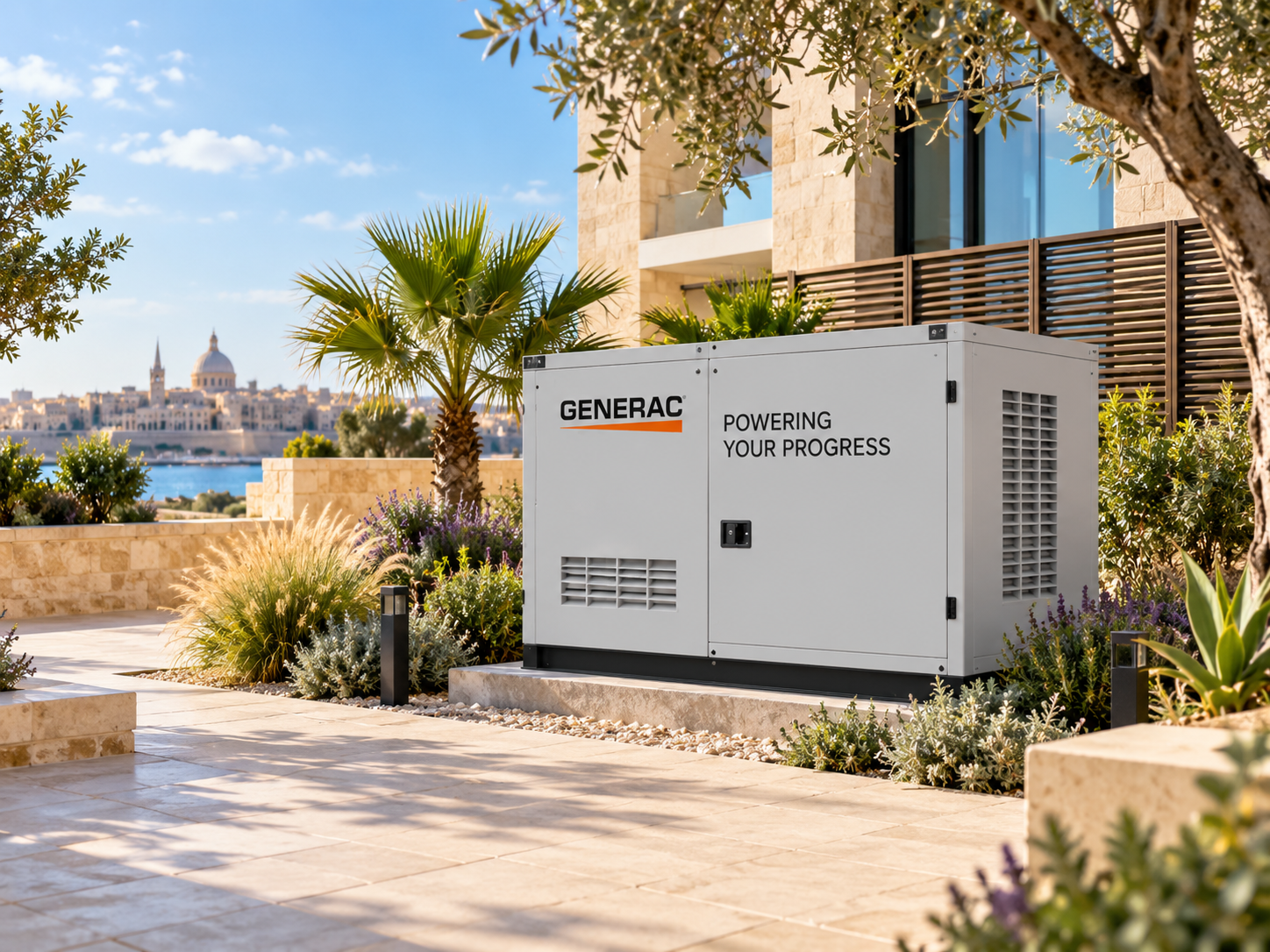
A landlord can truthfully say that a building has a backup generator while still telling a prospective tenant very little. The more useful question is: What exactly remains operational when the grid goes down?
A backup generator may cover:
- the entire leased office;
- only common areas and emergency lighting;
- lifts and essential building systems;
- selected tenant circuits;
- or only a limited critical load.
For an ordinary administrative business, partial backup may be perfectly adequate. For a 24/7 igaming, payment operations team or technology company running live customer support, the difference is substantial. The tenant therefore needs to understand generator capacity, usually stated in kVA or kW, and how much of that capacity is actually available to occupiers.
Then comes the next question: How does the backup generator starts?
A proper business-continuity setup normally involves an automatic transfer arrangement so that, when mains power disappears, the emergency system starts and the designated load transfers to backup power without someone having to find a key and walk downstairs. But even an automatic generator takes time to start.
Which is where the UPS enters the conversation.
Backup Generator ≠ UPS
A UPS is an uninterruptible power supply that provides immediate short-term power when electricity is interrupted. It can keep critical hardware running during the seconds or minutes before another power source becomes available.
A generator provides longer-duration power. Think of them as two layers: GRID FAILS → UPS HOLDS → BACKUP GENERATOR STARTS → OPERATIONS CONTINUE
That matters for equipment that does not appreciate suddenly going dark: servers, networking hardware, security infrastructure, access-control systems, workstations and telecommunications equipment. Some premium offices in Malta already combine both. For example, current OfficeMarket stock includes St Julian’s office space offering standby-generator and UPS systems alongside intelligent lighting, biometric access, network cabling and other technical infrastructure.
That is a better representation of what Grade A for a technology business increasingly looks like. Not only expensive finishes.
Then ask the question most tenants forget: how long?
A backup generator with ten minutes of fuel is not much of a business-continuity strategy. Technology-led tenants should understand:
- fuel capacity
- expected runtime under load
- refuelling arrangements
- maintenance responsibility
- testing frequency
- and priority during an extended outage.
A generator that has never been tested under realistic load is essentially a promise. For a business choosing between two otherwise comparable buildings, knowing that one landlord regularly tests its backup infrastructure and has an established maintenance procedure can be more useful than knowing which one installed the more expensive stone in reception.
Infrastructure that you hope never to use can still be one of the building’s most valuable features.
Cooling is infrastructure too
This is particularly relevant in Malta. If the office loses power in July but the desks remain powered while the air-conditioning does not, the theoretical backup strategy may have a very short useful life. Server rooms, communications equipment and dense technology environments generate heat continuously. So a technically informed tenant should ask:
Does backup generator also support cooling in the office space?
Does the building rely on one central cooling system? What happens if that system fails rather than the electricity supply? Are critical technical rooms independently cooled? Is there redundancy in pumps, chillers or other key components?
Not every company needs N+1 data-centre-style redundancy in its office building. But removing one single point of failure can be more valuable than adding one more premium finish.
Why Malta’s fintech and payments companies are asking more detailed questions
This conversation is particularly relevant to Malta’s financial-services ecosystem because resilience is not merely an IT department preference. The EU’s Digital Operational Resilience Act, DORA, has applied since January 2025 to financial entities within scope. It establishes requirements around ICT risk management, incident management, resilience testing and third-party ICT risk. The MFSA describes ICT risk and cybersecurity as a cross-sector supervisory priority.
In 2026 the MFSA went further, stressing that digital operational resilience must work in practice, rather than exist only in policies and documentation. DORA does not mean every fintech company is legally required to lease an office with a particular generator specification. That would be an overstatement. But it changes the mindset. If an organisation is expected to understand its operational dependencies, recovery arrangements and critical functions, the physical workplace becomes one of the dependencies worth examining.
A company may have beautifully redundant cloud infrastructure and still discover that its Malta operations team cannot work because:
the office has no power,
the router is down,
the cooling has stopped,
access control is unavailable,
and everybody’s laptop battery is at 11%.
Gaming has the same operational logic
Malta’s gaming industry is similarly technology-intensive. The Malta Gaming Authority defines several elements of gaming operations, including gaming, player and financial databases and control systems, as essential components, and its licensing framework includes technical documentation, system audits and reviews of operators’ technical setups.
A power cut may not take the gaming platform offline. But what about the people responsible for:
payments,
fraud,
risk,
customer support,
compliance,
incident response,
trading,
VIP management
or technology operations?
For a business that operates across time zones, continuity of the human operating layer matters too.
A new hierarchy of office amenities
A few years ago businesses searching for a new office might have ranked requirements like this: location → price → parking → finish → view
Today, digital business in Malta increasingly are looking at: connectivity → power resilience → location → technical infrastructure → price
A sea view is nice, but a server room that remains cool is essential. The two should probably not receive equal weighting.
OfficeMarket already categorises Malta offices with a backup generator, and current stock across St Julian’s, Gżira, Mrieħel, San Ġwann, Paola and other commercial areas increasingly advertises backup power alongside network cabling, fresh-air systems and technical infrastructure.