
How much office space does your company actually need, what should you budget for rent, and which costs are easy to overlook? A financial guide for businesses planning their next office in Malta.
What does office space cost in Malta in 2026?
The latest available KPMG–Malta Development Association property market report provides a useful starting point.
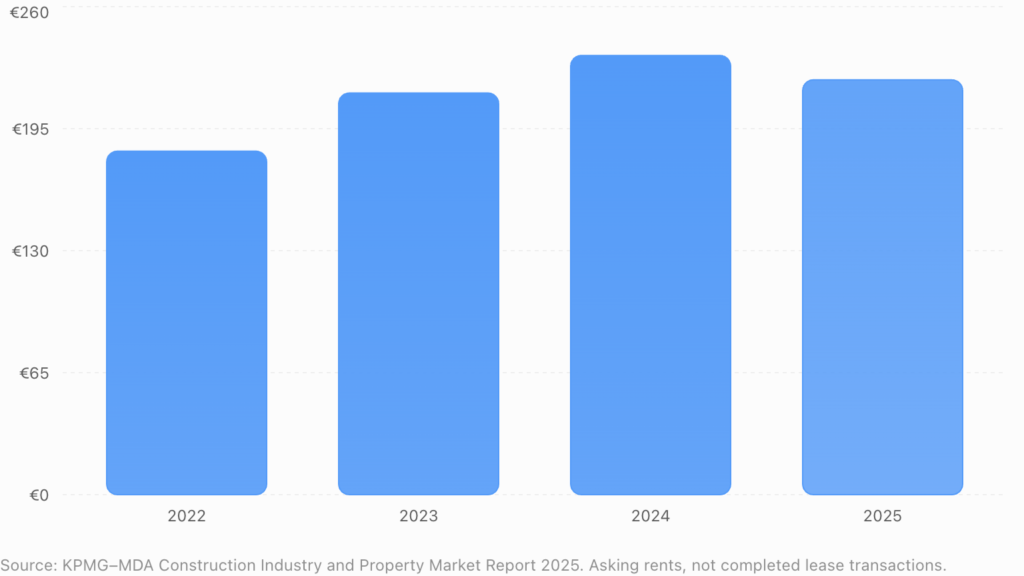
According to its December 2025 report, the average advertised rental rate for office space in Malta was approximately €221 per square metre annually in 2025, down from €234 in 2024.
These are asking rents, rather than the final prices tenants necessarily agree to pay. KPMG also highlighted subdued market conditions and the possibility of meaningful negotiations between landlords and prospective tenants.
Premium properties in desirable districts can still command substantial rents, while companies willing to consider alternative locations or older buildings may have more negotiating options.
How much does office location affect rental prices?
KPMG’s 2025 data highlights substantial differences between regions.
Malta region | Average asking rent per m²/year |
|---|---|
North Harbour | €263 |
Grand Harbour | €248 |
North West | €172 |
Central | €168 |
South | €134 |
How much office space do 20, 30 or 50 employees need?
Before calculating rent, businesses need to establish how much space they actually require.
A useful starting assumption for conventional offices is approximately 8–12 m² per employee, including an appropriate share of circulation and common facilities. This is a planning range, not a statutory minimum or a universal standard.
Actual requirements depend heavily on office configuration. A business with mostly open-plan desks may operate efficiently within a smaller area, while a company needing private offices, meeting rooms, client-facing facilities and confidential workspaces may require considerably more.
Team size | Indicative office area | Planning example |
|---|---|---|
20 employees | 160–240 m² | 200 m² |
30 employees | 240–360 m² | 300 m² |
50 employees | 400–600 m² | 500 m² |
These scenarios assume dedicated space for the stated number of employees, rather than a desk-sharing model.
The difference between 8 and 12 m² per person may appear small, but for a 50-person company it represents 200 m² of additional office space. At €221 per m² annually, that’s €44,200 in extra base rent every year.
The key question is therefore not simply how many people will occupy the office, but how much space the organisation needs to operate effectively.
A business should also consider expected growth. If a company currently employs 30 people but expects to reach 40 within 18 months, leasing an office that comfortably accommodates only 30 may create an early relocation problem.
What would a 20-, 30- or 50-person office actually cost?
Let’s look at three examples using advertised properties from OfficeMarket.mt.
These are real listing examples, rather than hypothetical rental rates. Prices were checked against the published listings in October 2026.
Availability, final rent, additional charges and lease conditions must be reconfirmed before a viewing.
20-Person Team · Sliema

200 m² prime office in Sliema – €4,100/month
A business-centre office with a boardroom, enclosed offices, networking infrastructure, backup generator and optional parking. Advertised as suitable for approximately 20–25 employees.
30-Person Team · Attard

300 m² modern office in Attard – €4,500/month
Modern open-plan office with air-conditioning, lift access and optional car spaces. The listing describes suitability for approximately 30–40 employees.
50-Person Team · Mrieħel

500 m² office in Mrieħel – €5,500/month
Larger open-plan premises with high ceilings, air-conditioning, lift access, backup generation and optional parking. The listing was last updated in May 2025, so its current status requires verification.
A 50-person company does not automatically qualify for cheaper rent per square metre. However, a larger company may have greater flexibility to consider commercial districts outside the highest-priced areas.
The comparison also demonstrates why relying on Malta’s average rent can be misleading. The individual property, its condition and the terms available are more relevant to a company’s actual budget than a single national market average.
The hidden costs of renting an office in Malta
Base rent is only one part of the financial calculation.
When comparing office properties, companies should request an itemised estimate of their total occupancy costs, preferably covering the entire proposed lease.
1. Common Area Maintenance (CAM)
Modern office buildings frequently charge tenants for maintaining shared facilities.
These charges may cover lift servicing, cleaning, common-area electricity, security, reception services and other building-management expenses.
For a 300 m² office, this could represent approximately €375–€1,250 monthly.
Before signing, businesses should clarify exactly what is included, whether charges can increase and whether they are calculated on the leased area or another basis.
2. VAT: potentially significant for cash flow
Malta’s standard VAT rate is 18%, but VAT treatment of commercial property is not as simple as adding 18% to every office lease.
The general exemption for property letting has exceptions, including certain transactions where a limited company leases property to an Article 10 VAT-registered business for its economic activity.
Whether the tenant can recover the VAT is a separate question, dependent on its activities and entitlement to input-tax deduction.
For example, if €4,500 monthly rent is subject to 18% VAT, the invoice would include an additional €810, resulting in €5,310 payable.
For a business entitled to full input VAT recovery, the long-term economic impact can be different from that of a business unable to recover it. However, both should consider the initial cash-flow requirements.
Financial businesses, including some firms operating in VAT-exempt sectors, should pay particular attention to this distinction.
3. Deposits and agency fees
Commercial leasing can involve substantial upfront commitments.
Security deposits are negotiable and commonly run to several months’ rent. Agency fees depend on the agreement and property; several OfficeMarket listings specify 7% or 10% of the first year’s rent plus VAT for the tenant.
Take the €4,500-per-month office example:
Upfront expense | Illustrative amount |
|---|---|
Three-month security deposit | €13,500 |
First month’s rent | €4,500 |
Agency fee at 10% of annual rent | €5,400 |
VAT on agency fee at 18% | €972 |
Subtotal | €24,372 |
This example excludes any VAT charged on the rent, fit-out expenses, furniture, relocation and initial operating costs. The deposit is normally security rather than an expense, provided it is returned in accordance with the lease.
An office advertised at €4,500 per month may therefore require well over €24,000 in initial cash commitments before employees move in.
4. Furniture, IT and fit-out
A property advertised as finished is not necessarily ready for occupation.
Companies should establish whether the office includes desks, chairs, meeting-room furniture, cabling, network equipment, partitions and kitchen appliances.
For a 50-person company, even modest costs per workstation can become significant. At an illustrative €700 per workstation, furnishing 50 desks would cost €35,000 before meeting rooms, storage, IT infrastructure or other fit-out work.
A more expensive furnished office may therefore be financially preferable to a cheaper vacant one, depending on the lease term and the investment required.
5. Electricity, air-conditioning and operating expenses
Energy use is particularly relevant for Malta offices where cooling, ventilation and IT equipment may run for extended hours.
A building’s electricity cost depends on its energy performance, floor area, equipment, occupancy and operating schedule.
Ask for previous utility bills wherever possible and review the property’s Energy Performance Certificate (EPC). A low rental price may become less attractive if the building requires high cooling expenditure or substantial maintenance.
The real monthly office budget: three worked scenarios
The following model combines the three OfficeMarket listings with illustrative operating expenses.
The CAM and utility figures are planning assumptions, not charges confirmed for those properties.
Monthly expense | 20 staff | 30 staff | 50 staff |
|---|---|---|---|
Advertised base rent | €4,100 | €4,500 | €5,500 |
CAM at €30/m²/year | €500 | €750 | €1,250 |
Utilities and internet, illustrative | €500 | €750 | €1,250 |
Estimated monthly running cost | €5,100 | €6,000 | €8,000 |
Annual running cost | €61,200 | €72,000 | €96,000 |
Cost per employee/month | €255 | €200 | €160 |
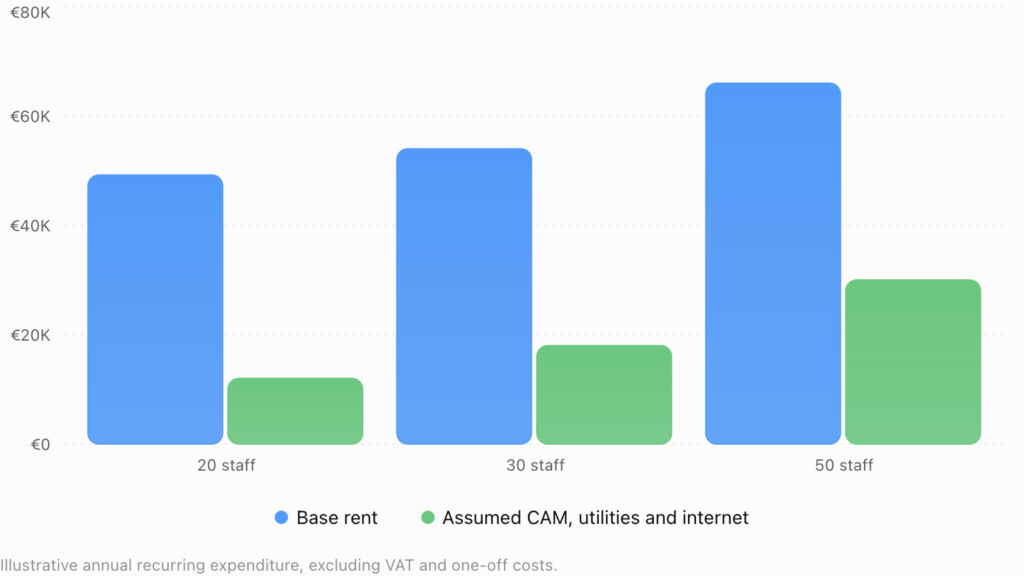
Illustrative occupancy budget using 200 m², 300 m² and 500 m² properties respectively. Excludes VAT, parking, insurance, furnishing, deposits, agency fees, fit-out, relocation and future rent increases. Actual costs may differ materially.
These examples show why an annual occupancy budget is often a more useful measure than advertised monthly rent.
Illustrative annual recurring expenditure, excluding VAT and one-off costs.
The financial implications become more substantial over a longer period.
An additional €1,000 per month in operating expenses represents €36,000 over three years. An extra €2,000 per month represents €72,000, assuming charges remain unchanged.
For a CFO preparing a three- or five-year occupancy budget, small monthly differences deserve serious attention.
Should a company rent more space now or move again later?
This is particularly important for businesses growing from 20 to 50 employees. Suppose a company currently requires 250 m², with the expectation of reaching 400 m² in two years.
The larger office will require additional rent immediately, even while part of it remains underused. The smaller property may save money in the short term but increase the likelihood of a future move.
A proper comparison should include the cost of the additional space, the expected recruitment timeline, any new fit-out, relocation costs and the financial consequences of early lease termination.
Businesses with uncertain growth projections may also want to assess serviced offices, managed workplaces or leases offering greater flexibility.
The economically sensible solution depends on the reliability of the company’s headcount forecast and the terms of the agreement.
What should businesses negotiate before signing an office lease?
Businesses should examine rent-review mechanisms, responsibility for repairs, service-charge calculations, furnishing obligations, permitted alterations, break clauses and reinstatement requirements.
A rent-free fit-out period, landlord contribution towards improvements or more flexible break provision may provide value even when the headline rent remains unchanged.
One particularly important issue is the obligation to return the office to its original condition when the lease ends. Removing partitions, cabling and tenant installations can involve substantial expense, so reinstatement obligations should be agreed before the lease is signed.
For longer leases, comparing the full contractual cost over three or five years is more meaningful than negotiating only the first month’s rent.
Frequently asked questions
How much does an office for 20 employees cost in Malta?
A 200 m² Sliema property advertised on OfficeMarket.mt is priced at €4,100 monthly. In our worked model, its estimated recurring occupancy budget is €5,100 monthly, including assumed CAM, utilities and internet, but excluding VAT and other costs.
How much should I budget for an office for 30 employees?
Using a 300 m² Attard listing at €4,500 monthly, our illustrative budget reaches €6,000 per month before VAT, parking and other potential expenses. Actual requirements depend on layout, location and building specification.
How much would renting an office for 50 employees cost?
A 500 m² Mrieħel listing provides an example at €5,500 monthly. Under our illustrative operating assumptions, this becomes €8,000 per month. This specific listing requires reconfirmation of its current price and availability.
Is office rent in Malta subject to VAT?
Certain commercial leases are subject to Malta’s standard 18% VAT, while other property lettings may be exempt. Whether VAT applies and whether the tenant can recover it depends on the transaction and the parties’ VAT circumstances. Seek tax advice before finalising the occupancy budget.
Choosing the right office is a financial decision with operational consequences.
For a business with 20 employees, a few hundred euros in additional monthly charges can materially change its budget. For a 50-person company, a poor decision involving location, layout or lease flexibility can create substantial costs over several years.
The latest market evidence also suggests that Malta’s office rental market is more nuanced than the assumption that commercial rents are continually rising. KPMG’s 2025 data showed a decline in average asking rents and pointed to negotiating opportunities, although differences across regions and building grades remain substantial.
Businesses planning an office move should therefore evaluate the complete occupancy cost, the space their workforce genuinely needs and the financial flexibility of the lease.
A commercially attractive office is one that supports the company’s operations at a sustainable cost, both today and over the years it intends to remain there.
Looking for an office in Malta for 20, 30 or 50 employees?
Explore offices for rent on OfficeMarket.mt or contact the OfficeMarket team with your preferred location, number of employees, budget and expected move-in date.